Sunday, December 8, 2019

Sign Posts

By Suzyika Nyimbili

Sourced from Google
Its 8th December, 2019. I am still in Budapest. One semester done! yay! Well, not really done as I still have papers to write and a meeting to discuss my thesis topic. Looking forward to finishing off all my papers and have a break from writing before the winter semester in Vienna starts. 

There is one thing that has stood out for me for this semester, 'Presenting oneself". Presenting ones ideas or whatever one would like to put across. Its a pretty hard task. Even harder in an environment where all everyone seems to be focusing on different topics and coming from different backgrounds.

In all this, I have come to learn to think more about the audience of my writing or presentation. As the presenter, its not enough to understand what you are presenting, its crucial that you present your work in a manner that helps your audience follow and understand. Of course your starting point should be making sure you understand your work and know the points you would like to put across.

In presenting ones work, "sign posts" are crucial, the audience should be guided. Something we talked about in our "Presenting Cultural Heritage Class. Not everyone might go the same way but your sign posts will help in giving direction. If your audience gets totally different ideas of what you are trying to communicate, its a sign to you and that maybe you need to rethink what or how you are communicating.  You might not necessarily be wrong but you might not  have put up your sign posts in the right points to guide your reader or audience.

It can be frustrating when you try to communicate something but it doesn't get to your audience. Try again, check your sign posts. How are you guiding your reader? Or maybe do you need to rethink your work?

I look forward to learning more and getting better at my writing in the coming months!


Monday, December 2, 2019

A Narrow(er) Topic and a New (?) Passion

(by Bori Mohácsi)

Maybe if I were still younger (ok, boomer) and attending a more old-fashioned institution, it would still be reason enough for me to start a new research topic that 'my supervisor suggested so'. So when this happened (the suggestion I mean), why did I dive headfirst (okay, sink gradually) into something seemingly completely new? (In this post, I'll explain that it's not so new, and I've done this before in practice, I just didn't know what it was exactly.)

How I've started out

I wouldn't want to bore anyone with the details of Hungarian legislation concerning archaeology from 2001 onwards – wait, I did that anyway, to most of my classmates, at several classes so far. Although at first I was somewhat baffled that nobody shares my outrage and curiosity towards a bunch of (alright, a huge amount of) legal paragraphs, and narrowing down the noble task of pointing out what's wrong with them felt like betraying what I've always believed in (yeah, it's a bit of correcting people when they're wrong, but also a lot of trying to save what's left of my country's archaeological heritage one article at a time). 

So why did I leave behind all this?

First, because as harsh as it is to admit it, I'm not a lawyer – and when people say that I should have been one, I should never, ever interpret it as a compliment. Second, because – and this is obvious for anyone not immersed in it – it was a huge topic. Pointing out what's wrong with the law of cultural heritage protection, addressing how it affects the practice of archaeology and giving it a new direction would be a several-year project for a team. And I'm only one person, and I have ~2 years (not even full time), so at some point, I had to do the math. Third, I've always gone for the hard stuff. And by hard stuff I mean subjects that barely anyone had dealt with before, and I've had to investigate 19th-century books and re-interpret artefacts for. But I didn't do that in 30 years like a German classicist some 200 years ago: I wanted immediate results.

No wonder it never worked as I wanted it to.


An academic breakdown

I don't know if that's a thing. Maybe it sounds way too dramatic. But when I've considered the topic my supervisor suggested (community archaeology), it sure felt like it.

Why?

Because it was too easy. It was too obvious. It was a soft topic and an idealistic one at that. And it's about actual living people, for crying out loud. I don't do that. I'm not a fluffy idealist, I'm a cold-hearted scientist who deals with facts, like dead people. And what they might have done, and how they might have behaved, which has nothing to do with...

You can probably see where I'm going with this.

Of course, I wasn't logical. 

And of course, by studying cultural heritage, I knew I'd have to deal with the living at some point. But community archaeology is exclusively about them, and I thought I wasn't ready for that.

So there's the breakdown.

Because any major change to an academic subject of your choosing, whether it's because of a suggestion, whether it's because you hit a wall, whether it's because data points to a different direction – does, in the end, make you re-evaluate your identity as a researcher. Most of the time, it's not a drastic change, but sometimes it's a sucker punch to your ego. But since what you've already tried wasn't working, you decide to go with it anyway.


Me? Community? No thanks. Yes, please!

So besides being afraid of starting a new subject that I knew nothing about, and for which I'd have to look at my whole profession from the outside, using methods I haven't used before (interviews, surveys, questionnaires, and evaluating them – you know, stuff you don't do with the dead), and dreading talking to actual living human beings, I was trying to keep an open mind.

I've tried to re-think my short professional life so far and to my shock, I realized I've already done a bit of community archaeology, as well as public archaeology. Mostly interpretation, as I've talked about exhibitions, excavations, concepts in archaeology and in Roman religion for people who didn't know anything about them, and at times weren't even interested. And I wasn't bad at it, moreover, I've genuinely enjoyed it.

I've also realized, that I'm interested in getting people involved in archaeology, and how my colleagues do that all over the country. I'm curious about good and bad practices, new initiatives, old ideas, and can't wait for observing it closely.

So as I got worked up, I had all kinds of ideas about how to approach my new topic, and although I'm 100% sure I won't be able to use all of them, I'm really excited to try as many as possible.

But am I allowed to pursue something fun and current and exciting as an academic subject?

The short answer is yes. The long answer is this egotistic rambling of a blog post, to which I hope some of the readers can relate.

I promise you the next one will be about my actual topic. At least I hope so.


Revelation’s Nostalgia - Nasser Alhamdi

Revolution’s Nostalgia


Nostalgia evokes the overwhelming past, regardless of whether they were bad or good moments, and it makes us feel them in an indescribable sensation. The odor, songs, places, and remembering are triggering the memories, and in one second or less, it is transferring us to the past and swirling us as autumn leaves in for a blow. There are always times when I feel very nostalgic, whenever I feel so, I think of jumping to feel I am still alive. However, I still remember the Lorenzo de' Medici Quote which I used to repeat: “How beautiful is youth, that is always slipping away! Whoever wants to be happy, let him be so: of tomorrow there's no knowing”.

My story is my country which is my family, friends, people, markets, streets, buildings, restaurants, mountains, stones, winds, rains, sunset, sunrise, and conversations. Unfortunately, nostalgia has been the only thing left whenever my country crosses my mind.

When the Arab Spring Revolutions started, I was very enthusiastic to participate in youth Yemeni revolution, we have had dreams to change the situation which was getting worse because the wars taking place in the north of Yemen, southern protests, poverty increasing, unemployment, corruption, lack of services, poor infrastructure, education weakness, and the absence of management in all institutions sectors, all these factors pushed us to go to the streets and demand for a better life.

I still remember how we would gather raising the slogans that asked the regime to leave, and sue the corrupted officials. I still remember the times we faced death while we were shouting in the streets, showing our faith in our revolutions and in its goals to construct the state institutions in my country. Once, I was with my friend and we decided to go for protesting against the regime, and while we were marching along the streets, the soldiers were waiting for us with their guns, and they started to shoot at us with tears gas. That time, I could not find my friend among the crowds. I ran away from those soldiers who attack us, and I climbed the fence with a two-meter height. I saw many people suffocate from the gas, I tried to help them and gave them some Oxygen spray. The demonstrators managed to repel the assaulters, and we could find a way to complete our protest. I was very worried about my friend because he moved to the first line against the soldiers after we separated, and I had news that five of the demonstrators were killed. When we finished the protest, I tried to call him, and I had the fear to hold the phone, I did not want to hear someone else answer me. As I heard the phone buzzer, my heart was beating so hard, I heard the voice, and It was him. We met after that, and we were very happy because we were totally fine although I inbreathed a lot of tears gas. We got back to our homes like heroes, and we were waving the Yemeni flag.

A lot of youth people believed in struggling to accomplish their dreams and Yemen’s future, but we realized that a sudden revolution it does not work enough, and everything has beginnings such as a volcano revolution. Of course, if we go back to history, almost all revolutions took a long time to set, but some of them took the wrong direction, and it has severe consequences. That is what I felt after a while because we missed the essential beginnings such as, awareness in our community, new thoughts and Philosophies, and writers that can correct the revolution path.

Now, the war destroyed every beautiful thing, especially good human manners and values. Heraclitus said “All things come into being by conflict of opposites, and the sum of things”, and some thinkers and Philosophers are agreed with him, and it could be if we learn from our mistakes in the past.

Sunday, December 1, 2019

“I’m surprised that it still stands”, or the Case of the Formerly “Red” Latvian Riflemen

(Károly TÓTH, 2YMA Comparative History, 2nd year)

Albergs–Driba: Latviešu strēlnieku piemineklis (1970–1971)
(own work)
Valdis Albergs’ 13-meters-high statue made of red granite – supported by a purist pedestral designed by Dzintars Driba –, originally entitled as Latviešu strēlnieku piemineklis (“Monument to the Latvian Red Riflemen”) stands in the central district of Riga, called Vecrīga (“Old Riga”) since 1971; in the year following its erection both of them received the prestigious State Prize of the USSR for this monument.


The “red” is dropped from the name, but the stars remained on the hats – Historical idiosincrasy or national reconciliation?
(own work)
Some Latvians think that the monumental statue on the Latviešu strēlnieku laukums (“Square of the Latvian Riflemen”) is a symbol of the Soviet past, while others claim that it is a necessary tribute to their own compatriots, who fought in the early period of the First World War. While checking the reviews of the monument on Google Maps, I found a comment of a Russian traveler as probably the most representative one: “Udivlyon chto on yeshcho stoit.” (“I’m surprised that it still stands.”)


To the Latvian R̶e̶d̶ ̶Riflemen?
(own work)
The Latvian rifleman regiments were originally formed in 1915 to defend Riga from the German Imperial Army. Later the total of about 40 000 troops were became a core of the future Red Army, and some of them became Lenin’s personal bodyguards. 

In 2000 the original inscription of the monument was altered from “Latviešu sarkanajiem strēlniekiem 1915-1920” ([Dedicated] to the Latvian Red Riflemen 1915-1920) by deleting the word red.

Thursday, November 28, 2019


What surprised me in the National Museum of Hungary? or
 the various statuses of Lenin’s & Stalin's statues in Hungary and Armenia

My interest in the current condition of communist period statues or their remnants in Hungary and Armenia started from the moment I visited the National Museum of Hungary in 2013. Upon entering the Soviet section of the museum, I was surprised very much when seeing remnants of Lenin’s statue - a hand and an ear displayed among the other objects of the communist period Hungary. It was completely new for me as I had never imagined them being represented in the museum context.


The remnants of Stalin's statue
        National Museum of Hungary,  2013


I found myself getting surprised at how Lenin’s statue can be represented when visited The Statue Park in Budapest this year.  After the end of the Communist regime in Hungary, the monuments of communist leaders (Lenin, Stalin, and others), as well as all the other communist theme monuments were demolished from Budapest and other parts of Hungary. Then, Statue Park was created, and all of them gained a new life in there. They were musicalized or were represented as museum objects. While having a walk in the park my reaction gradually turned from surprise to understanding and analyzing. These cases showed how societies can deal with their past and the material evidence of it such as monuments. Instead of rejecting, destroying and trying to forget, they just removed the symbols of the communist regime from daily life and made them museum objects. In this way, they both acknowledged the past as well as placed it at a distance trying to control its influence on the present.


                                        The Statue Park/Memento Park, 2019


Why I was surprised by seeing socialist period monuments or remnants in the National museum or in the Statue Park? Because I immediately made comparisons with the cases in Armenia and found the different situation there.
After the collapse of the USSR, the statues of communist leaders in Armenia were treated not as a respectful manner as in Hungary. Trying to reject the Soviet past and forget it, the statues were destroyed or put into storage. The most popular statue of Lenin located at the main square of the capital city Yerevan was demolished and taken to the storage within the yard of the National Museum. It is there till now left as if unnecessary objects in storage. Only one statue of Lenin “survived” in one of the remote villages. The statue appeared in the land of a family after land privatization, so the statue got owners who liked it as a work of art and did not destroy it.


                       Lenin’s statue, Arin village, 2015


                      Lenin’s statue, the yard of National Museum of Armenia
                                                 from pinterest.com, 2019

There is a more interesting case in Armenia about dealing with Lenin’s statue. In my hometown called Artik, the pedestal with Lenin’s legs seemed hard to destroy, so while removing the statue, this part remained in its place. As a result, the inhabitants have been living with these remnants until nowadays. The site has become a popular place to ask someone to meet “under Lenin’s legs’ or to ask taxi drivers to come and wait nearby “Lenin’s statue”. I would always see people sitting on the pedestal and having a chat. For young people, it is just a comfortable place to have a sit and sometimes use the pedestal surface for graffiti or love confessions such as Aram + Sima = Love. As for the older generation who experienced Soviet years, this place has many more meanings. For instance, when passing by the pedestal I would hear a group of aged people nostalgically recalling the Soviet years when the statue was “alive” and their lives seemed better. What I can state from these practices around the statue remnant is that it is still part of the daily life of the town, part of people’s meeting points and talks.


          the pedestal and legs of the former Lenin’s statue, 
                      2015, 2019

When comparing how the statues were officially treated in Armenia and Hungary, the following conclusions can be done: in both countries, the statues were demolished. However, in the case of Hungary we can notice a more organized and conceptual approach to the statues. They all were removed from urban and village landscapes and were musicalized. In case of Armenia trying to forget the past they “fought against the monuments” demolishing them, then destroying or hiding. However, it seems they did not do the task of knocking all the statues down successfully as the pedestal with the legs was left in one town and the whole statue in another village. They continue being part of people’s daily lives and memories.


COLLECTIVE MEMORY AND THE IMMORTALIZATION OF THE DEAD: THE CASE OF KAMUNGOMA LIBERATION CAMP-SITE

COLLECTIVE MEMORY AND THE IMMORTALIZATION OF THE DEAD: THE CASE OF KAMUNGOMA LIBERATION CAMP-SITE

Mutero Prosper

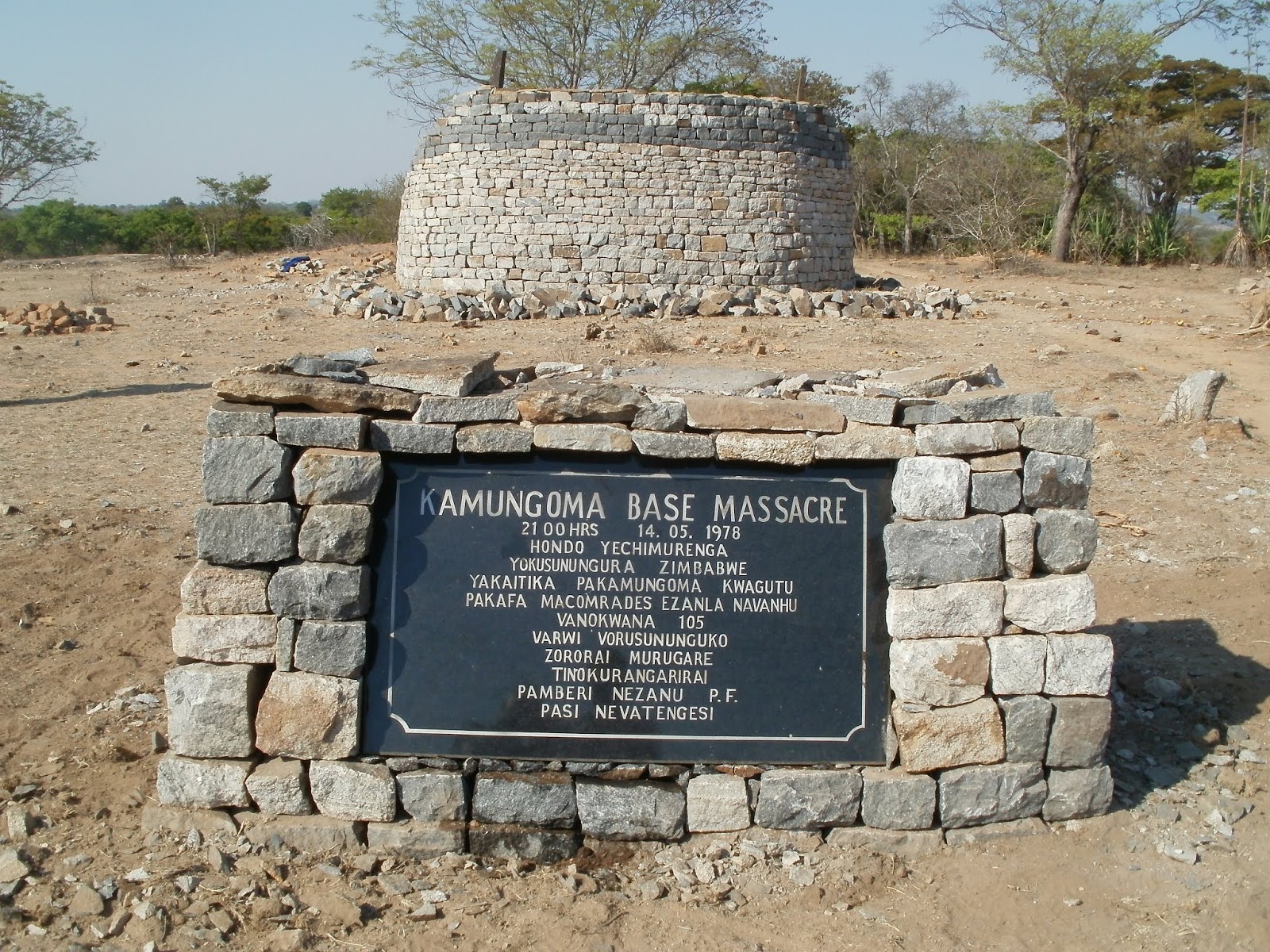
Kamungoma liberation war camp-site is situated 12 km Southeast of Bhasera growth point, which is in the South-eastern side of Zimbabwe. This site recorded the highest number of civilian people killed at the same time on a single day during the liberation struggle within Zimbabwe during the Zimbabwean liberation struggle. Locals holds the narrative that on the 14th of May 1978, about 105 people were killed by the Rhodesian forces during a pungwe (night vigil where the liberation fighters met and taught the masses about the strategies and reasons for the Liberation struggle). Amongst the contemporary locals is a number of individuals who are survivors to the 1978 event as well as relatives of those who perished. Ever since the 1980 when the country attained its independence, people in this part of Gutu area started commemorating such national holidays as the Heroes day, the Independence day, the Unity day at this very site. The celebrations however were done on this site most importantly to identify participants with the ruling Zanu pf political party as well as to commemorate the lives of the departed heroes. This community however approached the National Museums and Monuments of Zimbabwe (NMMZ) in the 2012, seeking the NMMZ’s intervention in constructing a memorial on the Kamungoma liberation war camp-site.


The community members
The NMMZ stone masons


The NMMZ had to do some research on the matter, as well as hosting planning meetings with the community leaders on what exactly was to be done.  A year later, on the 16th of October 2013, the NMMZ sent a team of nine to help the community erect a memorial at Kamungoma. Among the nine (all based at the Great Zimbabwe World Heritage Site) was the stone-masons as well as the two intern Honors student of which I was one of them. This team was being led by a curator of archaeology and it worked with the communities to construct the memorial which was built in a similarly to the Great Zimbabwe free-standing dry-stone structures.  The construction was regarded by the community as tangible form of remembering the dead and commemorating them. According to the community, the Great Zimbabwe known locally as the dzimbabwe meaning residence and burial of the kings/owned hence the dry stone structure as well as the conical tower was the best possible way of immortalizing the memory both of the event and the people who perished at this very site. A black graphited panel with inscriptions of the manes of those who perished during the massacre placed on the wall and this was done to ensure their being remembered.

The site after completion of the memorial 

Wednesday, November 27, 2019


Buongiorno Italia or where To Find Beauty In Milan

by Arina Govorina

Since early childhood, I always knew that Italy is the best place to discover world heritage history and explore amazing culture. Later I found out that each part of this country in most cases has own traditions, architecture and even dialects. Being inspired by picturesque landscape of Amalfi coast, great history of Rome and romantic Venice, one day I booked tickets to Italy and randomly chose Milan.

The most famous and recognizable symbol of Milan is Duomo Cathedral. Located in the heart of Milan, Duomo attracts both local people and travellers. Construction work of Milan Cathedral lasted over six centuries and now everybody can explore the beauty of this place. This Gothic-style cathedral covered with white and pink marble has more than 3400 statues that decorate the building. Inside the cathedral everybody can see the elegant interior with sculpted marble columns and go to the rooftop terrace to enjoy an amazing panoramic view of Milan.


Duomo di Milano

Galleria Vittorio Emanuele II is the other place that cannot be missed when you visit Milan. Being the oldest active shopping mall in Italy, this site became a favorite meeting point both for tourists and local people. Usually, people spend a lot of hours in Galleria admiring its magnificent arch, a stunning glass ceiling and eclectic luxury style.

Galleria Vittorio Emanuele II

Visited the top two Milanese sites, I could not find any more beautiful buildings. Google suggested me to take a train to Rome or just go shopping. I decided to stay in Milan and prove that it has more than two beautiful places. Who knows more about a city than a person who was born and bred there? Local people like to say that Milan is the brain of Italy. It is responsible for economics, business and money issues, not beauty. That’s why sometimes the city seems gray and even gloomy and does not have many cultural heritage sites. The best example of it can be Torre Velasca, a skyscraper known as one of the world ugliest buildings according to opinion of architects. Despite its terrible exterior, Torre Velasca is an expensive place to live in (the famous Milanese joke: you have to pay a lot of money to live in Torre Velasca because only here you can enjoy the city view without seeing this building).

Torre Velasca

Probably, Milan is not the best place to explore the diversity of Italian culture and heritage. But here you still can find something interesting and even attractive. Sometimes beauty does not mean great architecture, picturesque natural sites or famous historical places. If you try, you will find beauty in small urban details from window decoration to old bicycles in the central park.  

Milanese atmosphere 

Have you ever been to Italy? What places and why would you recommend to visit?

Tuesday, November 26, 2019

WHEN SEARCHING FOR ROAMING CATTLE AMIDST THE MIST: THE CROSSROAD OF DEVELOPING A THESIS PROJECT


WHEN SEARCHING FOR ROAMING CATTLE AMIDST THE MIST: THE CROSSROAD OF DEVELOPING A THESIS PROJECT
Mutero Prosper

I remember the old days back-home when I used to herd my uncle’s cattle, how he would to send us to gather the cattle in the mountain range during the rainy and misty winter days. Usually after harvesting our fields (thus the winter season) we would let the cattle to roam in the nearby Dindingwe mountain range for some days, and then later I and my cousins would then go to search for them. We would wonder in the mountain range searching for the cattle till we find them, despite the misty nor the cold. I am now finding the same experiences similar to that of developing a thesis project, for the completion of my masters’ study at the Central European University (CEU).
I remember how we would plan our search in the company of our uncle, and how we usually promised him of our quick return from the mountain. This appears to be the stage when one is applying for admission at the University and is also submitting a prospectus. To the writer, it appears final and comprehensive, many times a time-plan projection is drawn within the prospectors stipulating what the applicant perceives as the milestones. However after being admitted, one would then realize that either the scope of the research was either too big to be attainable in the given time period, or it’s just not practical, or just that the study has been done else-where. While wondering in the midst, we wouldn’t be sure of the direction or where exactly to find the cattle, but often we would ask ourselves on what to do next.
There are more than five hills in the Dindingwe mountain range where we would the cattle roam to graze. We usually guessed where among these hills we would find the cattle and sometimes times we would have to listen to the mooing, the bells or we would consult among ourselves on how to proceed on our search. At the CEU, one has to consider seriously the planning sessions with the supervisors. My meetings with my supervisors have been very helpful. Many are times when you find hardships in understanding some concepts or when you just feel like you are missing the direction, the supervisor redirects and explain things around. My research project is on the preservation of human remains in Zimbabwe and at first I didn’t really know what area to tackle for this is a broad research area. However after consultation and having looked at the available data and resources, I have decided to go for a more practical than theoretical thesis project. Since we do not have guiding instruments on the museology conduct and preservation of mortuary heritage, I realized the need to come up with a policy on the preservation and management of the human remains in Zimbabwe.
In the mountain range searching for the cattle, we would come across wild fruits which we would spare not. One of my older cousins Peter would always climb the trees and get the fruits for us. I find my class being an interesting one, with very amazing individuals.  Indeed we are not academic robots, there are times we arrange small get-together functions just to relax and shaking off the academic stress. We sometimes coordinate ourselves and get together and exploring Hungarian foodstuffs, drinks and places. This however does not remove our attention from our academic pursuits, but gives us the necessary break to freshen-up, refocus and engage on a better dimension. Indeed, there is no way we can do without the third model of Maslow’s hierarchy of needs, which is enveloped in love and belongingness. Our class is one of those amazing communities that has accepted the notions of intercultural and interreligious tolerance and as a result, we manage to give positive criticism and positive feedback on one another’s thesis prospectus and research ideas.
There are taught courses that I have to attend in this journey of attaining my masters’ certificate with the Central European University. Various concepts in the study of Culture and Heritage have been made known to me and it’s even a matter of choosing which one I would like to include in my research. I have noted how for example cultural heritage policy course is so key to my study since I would like to come up with one. This however would not mean that other courses are of no significance for they all avail important insights into the heritage related issues, for example language and identity issues, memory and remembering, the presentation of heritage and other issues. Having these concepts and those from the coming semester classes, I do hope to complete my thesis in the timeframe provided by the department.

Monday, November 25, 2019


Nataliia Tomenko
Representation of Roma Female as Fortuneteller in Mass Culture


Shoot from the Bremen Musicians


During the observation of visual sources, I was surprised how antigypsyist some animated cartoons produced for children around the 1970s both to the USSR and US are. The Bremen Musicians produced in the Soviet Union (here and after, SU; movies were filmed in 1969 and 1973) and Robin Hood (1973) created in the United States provide a very similar depiction based on sexualization, sexual objectification, gender discrimination and orientalization, also offering very strong racial discrimination and oppression towards Roma. Even though the political regimes in the two countries were different, capitalism in the US and communism in the USSR, the treatment of Roma was the same with a range of stereotypical messages.

The first cartoon, Bremen Musicians has video clip with depiction of “Gypsies” performing dances and singing songs. It begins with a general view of the hut in the forest which looks in the medieval way. The heroes, who look like robbers, sing about their dangerous life style (activities). The gang consists of 3 men with appearance of robbers (with knives and daggers) and one woman who looks like the gang leader. She performs fortune telling with the use of a regular pack of cards (which you can buy on each corner), which seems slightly  unconvincing, because normally the prediction of the future happens by virtue of Tarot cards. This aspect shows a criminal reference, as far as in the USSR, prisoners entertained themselves playing games with regular cards. The sequence shows contemporary prisoner’s culture framed into the atmosphere of the Middle Ages. The woman is depicted with particular attributes of a stereotypical “Gypsy” female person (with golden rings, bracelet, necklace). The sexualization in the depiction presence as (big bulk of female “Gypsy” body, big breasts and bulky bottom body part, red lipstick, stereotypical clothes (long, tight skirt)). 


Shoot from the Robin Hood


The second animated cartoon, Robin Hood (1973), created in the United States, has a sequence depicting Gypsies which starts from background of forest with heroes in clothes from the Middle Ages. The cartoon in general shows Robin Hood as a criminal figure with good image who robs from the rich to help poor people, there is a difference compared to the Soviet cartoon where criminals are displayed as a negative force. In the Medieval setting of the Robin Hood, the King’s convoy goes through the forest, and the Fox (Robin Hood) together with the Bear (Friar Tuck) intend to rob the King.. The King’s counselor snake is depicted as a negative hero with magic (hypnotic) skills. The shoot continues with an image of “Gypsies” (disguised Robin Hood and Friar Tuck) offering the King to predict his future, greeting him and simultaneously stealing precious stones from his jewelry successfully. They perform a magic ritual for the King pronouncing unknown, randomly created words using crystal ball. During the ritual “Gypsy” female figure tries to steal the gold but the snake interrupts it. Just when the king closes the snake in the basket, immediately the Wise women steal all the goods and leave the King’s shelter. On their way “Gypsies” steal everything valuable they see, even the golden caps on the wheels of the coach (there is the similarities with the Soviet cartoon, where a “gypsy” also carries the stolen wheels). The appearance of two “Gypsy” females shows the bulky body shapes, stereotypical clothes (long skirt), accessories, and dark skin, which can be because of animal origin of figures. 

As far as culture is an essential part of nationalism it was also affected by the Cold War. As both countries asserted, motion image was as a form of strategic weapon. During that time cinema and cartoon productions were controlled and shaped in US by the Motion Picture Alliance for the Preservation of American Ideals and FBI, in the same time in Soviet Union that role executed government. The FBI put efforts to create in Cinema the image of America as the protector of the American people and to blacklist Communists, the same Soviet government facilitated to produce movies to spread negative propaganda towards US. Some of movies even were banned for being insufficiently patriotic. Many of SU films were focused on spreading a positive image of Soviet life with the goal to prove that Soviet life was better than American one.
The outcome shows that both countries oppressed Roma for being the other, and this “otherness” is very much intersectional. The explanation is that this kind of stereotypes  lies on a deeper level, as psychologists say, on a stage of “first desires”. It is there where, from the point on view of a White European Male (dominant gaze), the representational intersectionality of “Gypsy” females as fortunetellers was established, and it explains how pop culture portraits non-white women. 
Also, Medievalist stylization of depictions would add another degree of oppression to this representational intersectionality, because being a fortune teller in the Middle Ages very often meant a risk of being accused in witchcraft. To some extent, it gives the modern people an illusion that Roma do fit somewhere, at least the Medieval period with its relative tolerance to harmless magic. So, antygypsyist stereotypes have to be observed, analyzed and removed from Mass Culture with aim to promote the real image of Roma culture. 

Friday, November 15, 2019

As promised, some technical advice that you really don't need, but might make you laugh, from Catinca.

Chapter VI: Begin by being honest 

It is a truth universally acknowledged that a young student in possession of a thesis topic must be in need of advice. Luckily, there is plenty of it on offer here at CEU. 
As you may remember from my previous instalments, this whole thesis debacle started with a passion. As much as I was in love with my topic, I was very anxious to share that with faculty. This is an academic institution, right? 

Science!
Rigour!
Citations!
Theories! 

How could I walk into my supervisor's office with feelings as a methodology? But, dear reader, that is exactly what I did. I spoke openly with my supervisor, we discussed motivations and plans, and guess what? Not only was it a cathartic experience, it was productive as well. We came up with a plan! And a methodology! But I am getting ahead of myself. 

What I am trying to say is, be honest with your advisors. Tell them your fears, your ideas and do not be afraid to stand your ground. If you are very attached to an idea or concept, find arguments to convince them it is a good idea. Be creative in the ways you could integrate it in the thesis. You don't have to let go of the soul of your project. A supervisor will help make sense of your (sometimes messy) ideas and you will figure out a good outcome together. But talk to them you must, young padawan. 

Chapter VII: Research and (actual) methodology (and some practical advice)

Time to talk about Bucharest again. Do you know what a mahala is? Bucharest used to be made of them. People still use the term today. 

mahala: word of turkish origin meaning simply neighbourhood. Only after the urbanisation following western models started in the 1830's the word acquired a negative connotation of a marginal space. These were spaces 'outside the citadel walls', where minorities and merchants usually dwelled. Most of these unplanned, often poor, organically developed neighbourhoods disappeared, either integrated into the city, or demolished for modernisation. 

Why am I telling you this? Because these are the basic urban cells from which the urban space developed. One can still see their traces today. Small merchant's homes, some only a little more than huts. They are heritage too. They are part of urban history as much as the neoclassical palaces I was crying about in part 1. And the thing is, I only found out about their significance during my research for my Jewish Cultural Heritage module.

Just because something isn't specifically 'thesis research', that doesn't mean it isn't useful thesis research.

Furthermore, thinking about these neglected heritage sites I realised the underlying concept of my thesis. Community involvement blah blah. Heritage reuse blah blah. But what was the underlying connection? And it dawned on me that it was authenticity. My idea of asking people what shape they want adaptive reuse projects to take in their ares was fuelled by the unconscious thought of a 'geist', an intanglible aspect of local heritage that I wanted to see manifested in heritage reuse. And I finally realised this by coming clean to my supervisor about my motivation. I used the word vibe a lot. But it is true that some places have a vibe, a je ne sais quoi that results from their history and heritage. The academic terms for that fall somewhere between intangible heritage and authenticity.

Just because some of your ideas don't sound academic, that doesn't mean that there isn't a useful concept underneath it all.


Chapter VIII: She reads, she writes, she reads more, she re-writes

So from this idea, my supervisor recommended I look into the concept of Historical Urban Landscape. I just checked out 3 books on the topic. Thing is, it may not be suitable. It may be the most useful thing ever. But I will never know unless I study it. So read. Read everything. Read it all. Even when you watch Netflix, keep an eye out for ideas. When you walk around the city. On the metro. All research is good research. And by the end, you will know what is useful for you. (More than that, you will sound hella smart.)

Pro tip: keep a notebook with you at all times and every time you a have thought about your thesis write it down. It might me amazing. You may never remember it again.

And with all this research, your ideas will naturally change. Your biases will be challenged, your assumptions unveiled. But everyone says to narrow down the topic. How does this technique help, you may ask. Well, the answer is counterintuitive, but bear with me. The more you read around the topic, you will find out a lot of things you don't need. Which is exactly the point. The more you know what is irrelevant, or belongs in a different research area, the easier it will be to define your are and hedge ( ͡° ͜ʖ ͡°)effectively. 

That's all the cliche advice I could come up with, based on my meagre personal experience. Hope it helps! 


Cliche Appendix:

1. All bad thesis are bad in the same way, but all good thesis are good in their own unique way. (if Anna Karenina wrote a thesis)
2. It was the best of times, it was the worst of times, it was the age of research, it was the age of procrastination, it was an epoch of learning, it was an epoch of waking up late, it was the season of presentations, it was the season of essays, it was the spring in Vienna, it was the winter in Budapest, we had a BA before us, we had a prospectus before us, we were all getting an MA. (A tale of two years at CHSP)
3. In my younger and more vulnerable years, my supervisor gave me some advice that I've been turning around in my mind ever since: every time you feel like criticising anyone, remember peer reviewing. (The Great Prof. Dr. Gatsby).
4. As students fro CHSP awoke one morning from uneasy dreams, they found themselves transformed in their beds into monstrous bibliographies. (The Metamorphosis)