Sunday, February 16, 2020

Inspired by the East: When you cannot escape the discourse of Orientalism! 2


The Prayer 

Zeinab Abdelhamed

In this part, I would like to look at one of the examples that the exhibition had. The Prayer (see figure 1) by Frederick Arthur Bridgman. An American, who was celebrated for his use of detail, such as here the carpet and shoes, and respect for Islam. Indeed you can clearly see the details of this work of art. My quest was to what extinct this painting represents in any way the Islamic world or culture the co-curator talked about. From the first look, one can notice the influence of Christian art in the depiction of Jesus on the position of the main figure. On the contrary to the prayer position in Islam. (See figure 2).

Figure 1 ( The Prayer)
               A great number of Orientalists for nearly a century applied themselves to the study and the scrutiny of Islamic art and architecture. They did a magnificent job regarding classification such as place of origin, the period of production, styles, and so on and so forth. This was a great achievement, but it has drastically undermined the wider understanding and discourse of Islamic art and architecture-- especially in terms of the connections of Islamic art and architecture to Islam as a religion. Islam, the world's third monotheistic faith, was born and developed in the Arabic Peninsula in the seventh century. Islam is not only a religion but a way of life; Islam fostered the development of a distinctive culture with its own unique artistic language that is reflected in art and architecture throughout the Muslim world. Mainly, Islam bears witness that there is no God but God, “Tawhid,” and attributes everything and anything to him and him alone. This, of course,  includes all art and architecture. This fundamental idea was omitted in the classification discourse that was defined by Western art and architectural historical approach with severe limits of knowledge about the language, culture, and religion of the East. The unfortunate outcome of this bias was a forcible compression of Islamic art and architecture with Christian art and architecture in the massive catalogs and classifying materials that were produced.
figure 2 ( praying positions in Islam)

Towards a new perspective

In his article, Grabar, mentioned that “The views and opinions which are here expressed were developed as a Western observer sought to understand art. They do not derive from a Muslim experience, and it is indeed a problem faced by nearly all scholars in the field…
By the implication from this, there is a sense that deep Muslim experience is necessary in order to fully understand the Islamic art and architecture.
To conclude, in a post-colonial phase, scholars of Islamic Art and Architecture should bring a critical eye to the study of the Orientalists’ methodology and statements.My recommendation as a student and future scholar who will write in this domain is to take into consideration the achievements of the medieval Muslim world and its identity as shaped by Islam, and the essentiality of liberating Islamic art and architecture from the ill-informed confines of the Orientalist construct. This new perspective should include critical analysis of classification methodology elements that have been deeply entrenched in generations of discourse on Islamic Art and Architecture.

P.S. Thank you, Suzy! 
Reference:
https://www.youtube.com/watch?v=g56M4dDOde4
  • Said, Edward W. 1978. Orientalism. New York: Pantheon Books.
  • Grabar, Oleg. "What Makes Islamic Art Islamic?" In Islamic Art and Beyond, volume III, Constructing the Study of Islamic Art. Hampshire: Ashgate Publishing Limited, 2006. First published in AARP, 9 (1976)

Saturday, February 1, 2020

The Death Sentence of a Museum? by Bori Mohácsi

I was meant to write my next post about community archaeology, but something happened very recently that made me livid, and I simply had to react – and since I’ve been writing a blog post, here it goes. I know, the title is rather dramatic, but it is, in fact, quite close to becoming a reality.


The Museum
The Hungarian Natural History Museum was a part of the Hungarian National Museum ever since its founding by Count Ferenc Széchenyi in 1802. It housed the botanical, paleontological, geological and later on, the anthropological collection of the National Museum, and by the end of the century, it had to be separated since it threatened to outgrow the building.

For almost 100 years exhibitions were set up separately in various parts of the city, while the museologists were trying to protect the collections from two world wars and a revolution as well (semi-successfully). Finally, in 1994, the Hungarian Parliament decided to give the Natural History Museum a new building, more precisely, several ones: the campus of the old military academy, the Ludovica. The plan was to renovate the complex and give a permanent home for all of the collections by the end of the 2000s, so they started moving them in from separate premises while opening their first exhibit in 1996, “Man and Nature in Hungary”, which was seen by the author as a kindergartener.


And then what happened?


Even the official about page of the museum is addressing – although in a rather contained manner – the problem at hand: Unfortunately – as a result of changes in political decisions concerning the museum – other collections were not able to be moved to this location but rather remained in separate premises. To find a permanent place for all the collections and exhibitions is now the biggest problem the museum has to face.

The main entrance of the museum today
It’s true: there have been several changes since the late 1990s, however, the biggest one is fairly recent: in 2012, a newly founded university was moved in the main building of the former Ludovica Academy: the National University of Public Service. The intention was clear: to expand the university while making the museum move to a yet unknown location. Thus, the university is expanding ever since, they even started building an additional campus around the premises, while the museum, its collections and exhibitions share the old campus with it (mainly the manege, part of the main building and the renovated underground building complex). It used to be surreal as a researcher: looking for the small doorman’s table of the museum next to the shiny, new reception of the university to let us underground to the Anthropological Collection.


Ok, but what is going on now?

Another move, it seems. But this one is not like the others: this is planned to be permanent, and also very likely to be lethal to the collection. Moreover, downright impossible, as it is to an undisclosed (i.e. not even built) location in (drumroll) Debrecen.

Of course, this doesn’t say much to my fellow colleagues who are not from Hungary, so: Debrecen is the second-largest city in the country with more than 200,000 residents (compared to Budapest’s 1,750,000), circa 222 kms from the capital, close to the Romanian border. Why there? No clue. Some say it’s the city council’s loyalty to the government, but we do not know that for sure.

It's boxing day for these guys soon
What we do know, however, is the following: the government issued a non-public edict in January, that by the end of the year the museum has to move all of its collections and exhibitions out of the Ludovica premises. By then, of course, the Debrecen complex will not even be started, so the more than 10 million pieces of individual artefacts, 450 thousand volumes of the library, 8,000 pieces of archive photos, 1,500 pieces of archived documentation, furniture, technology, laboratories, etc. will have to be placed in a temporary warehouse. Which will already have been pre-packed by the 171 people working there. Sounds feasible, doesn’t it?

Even if, due to some kind of a miracle, the moving could be done, doing it in such a hurry would permanently damage some of the collection. The greatest danger is posed to the most delicate material, such as the 264 mummies from the 18–19th century excavated in the White Temple of Vác.

*


This is the part when I should say something comforting, but I won't, because I can’t. This is a problem often faced by professionals in cultural heritage who work in countries where politics has a top-down approach to everything: they have to improvise in the most absurd conditions in survival mode, trying to protect irreplaceable artefacts and heritage sites – in an eternal mood of justified fury against politicians. I have no answers for this now, but maybe, just maybe, that’s why I’m studying cultural heritage now, so maybe one day I will.

Saturday, January 18, 2020

Why Archaeology? (a Very Short Manifesto by Bori Mohácsi)

From time to time I like to think about why I have chosen the specific field I’m in (well, for now, on the side of). It’s part of my overthinking routine, sure, but it also makes me check in with myself if I still enjoy it as much as when I started some 10 years ago. Basically, if I still see the point of doing it, or I can quit without regret and do something corporate for way more money.

Aside from why not, it’s always been one of my favourite answers to give. Because archaeology is a wordless conversation with the past. It is, of course, history, in a sense that you study the past, and if there is a written source material of your studied era and location, you will have to use it. But archaeology is something different: it is conversing with the remains of societies, with what’s left of tools and cities and treasures and people, physical evidence. It is a methodology that helps you understand what these remains say without words and a tool that helps you interpret it.

Archaeology is data science and hard physical work and art history and anthropology and so much more, and, in the end, it is also storytelling. By connecting the dots of evidence we tell the stories of long lost people and their lives, people who otherwise would not have been remembered, not even as part of a certain population. People who have little to no voice in history books even after the invention of writing: women, children, lower-class people, ethnic minorities, people conquered by a stronger military – people on the bottom. The 99%. I remember when I first started at university, that was what fascinated me the most, and tickled my sense of justice. I get to learn about the non-elite! How they dressed and cooked and traded goods, what actually happened in the meantime of politics and military campaigns. You know, the really important stuff. Life, I guess.

And when you meet this kind of evidence: bones and gold and dust and bricks, stuff that, in the end, you and your beloved are made of… well, you want to do it right. You want to tell the right story. So you have to be good at it. 

That’s why you need archaeology.


Also, digging is a lot of fun.


Wednesday, January 1, 2020

How the artist in search of becoming a researcher?! Or so What?
Chinara Majidova 


After the presentation of my thesis topic, I understood how broad is it and I became confused in my future direction with it. Now I have even more questions in my mind about it than before. The main one is it possible to separate tangible heritage from intangible in “Sovetskie’ neighborhood? Do I want to separate them or it is just for narrowing the topic? What impact it will bring for the community and my hometown with my research?

I started to analyze what I was doing before as the artist and how it is now different from the researcher perspective. In 2018, I and my colleagues with whom we were working on this project got support from Yarat NGO which dedicated to nurturing an understanding of contemporary art and organized “Mehelle” (neighborhood) exhibition.

More information about the exhibition you can find in the links below:


From "Mehelle" exhibition. Photo by Mike Raybourne 


The uniqueness of this exhibition was not only in presenting this topic in public between the people who usually attend exhibitions but also that we tried to engage and invite Sovetski residents to the exhibition. İn result, Sovetski neighborhood community was not only presented there as an art and documentary subject but also was invited as exhibition visitors. A lot of people recognized their streets, houses, and people on the TV screens of the exhibition and was a part of Meykhana performance, which took the place at the closing of the exhibition. For the people who is not familiar with Meykhana meaning here is sort description is a distinctive Azerbaijani literary and folk rap tradition.İt was important for us to see them there because they are the one who opened the doors to us to our cameras and shared with us their lives.

From "Mehelle" exhibition. Photo by Mike Raybourne 


Looking to all past now I ask the most important question in for any thesis topic “So what?” What will you research for your thesis?
                                                                                                                                  
So firstly I decided to get more information about the community which was living there. Maybe then I will know where to move.  I know more or less about build monuments but what I know about the community? Who they are? How they appeared there and what were the values of this community?
I started my research from two interesting books one is Bailyn, John Frederick, ed. The Future of (post) socialism: Eastern European Perspectives. 


Which gives information about backyards and Bakuvian understanding: The bakinets, or Bakuvian, lived in Baku and reportedly became a unique ethnos, a “nationality” that encompassed a wide range of nations, including Russians, Armenians, Azerbaijanis, Georgians, Tatars, Ukrainians, Jews, and other nationalities of the southern Caucasus. Diverse in class as well as ethnicity, the bakinets encompassed intellectuals, workers, and even rough- and- ready urban gangs that were, as Stephenson (2015) notes, neither anti- Soviet nor deviant, but rather the product of informal alliances that frequently intersected with formal and state-sanctioned institutions.

From   the movie " In one South city"1969


The second important book for my research now is Hatton-Proulx, Clarence. "Baku: oil and urbanism: by Eve Blau, Ivan Rupnik, and Iwan Baan. It gives the picture of Baku urban planning in the past and present which was changed with the oil boom and Independence.


Besides my research paper, I am also thinking now on collecting more data from the family archives with stories behind which at the end can be the part of a new art project.

Sunday, December 8, 2019

Sign Posts

By Suzyika Nyimbili

Sourced from Google
Its 8th December, 2019. I am still in Budapest. One semester done! yay! Well, not really done as I still have papers to write and a meeting to discuss my thesis topic. Looking forward to finishing off all my papers and have a break from writing before the winter semester in Vienna starts. 

There is one thing that has stood out for me for this semester, 'Presenting oneself". Presenting ones ideas or whatever one would like to put across. Its a pretty hard task. Even harder in an environment where all everyone seems to be focusing on different topics and coming from different backgrounds.

In all this, I have come to learn to think more about the audience of my writing or presentation. As the presenter, its not enough to understand what you are presenting, its crucial that you present your work in a manner that helps your audience follow and understand. Of course your starting point should be making sure you understand your work and know the points you would like to put across.

In presenting ones work, "sign posts" are crucial, the audience should be guided. Something we talked about in our "Presenting Cultural Heritage Class. Not everyone might go the same way but your sign posts will help in giving direction. If your audience gets totally different ideas of what you are trying to communicate, its a sign to you and that maybe you need to rethink what or how you are communicating.  You might not necessarily be wrong but you might not  have put up your sign posts in the right points to guide your reader or audience.

It can be frustrating when you try to communicate something but it doesn't get to your audience. Try again, check your sign posts. How are you guiding your reader? Or maybe do you need to rethink your work?

I look forward to learning more and getting better at my writing in the coming months!


Monday, December 2, 2019

A Narrow(er) Topic and a New (?) Passion

(by Bori Mohácsi)

Maybe if I were still younger (ok, boomer) and attending a more old-fashioned institution, it would still be reason enough for me to start a new research topic that 'my supervisor suggested so'. So when this happened (the suggestion I mean), why did I dive headfirst (okay, sink gradually) into something seemingly completely new? (In this post, I'll explain that it's not so new, and I've done this before in practice, I just didn't know what it was exactly.)

How I've started out

I wouldn't want to bore anyone with the details of Hungarian legislation concerning archaeology from 2001 onwards – wait, I did that anyway, to most of my classmates, at several classes so far. Although at first I was somewhat baffled that nobody shares my outrage and curiosity towards a bunch of (alright, a huge amount of) legal paragraphs, and narrowing down the noble task of pointing out what's wrong with them felt like betraying what I've always believed in (yeah, it's a bit of correcting people when they're wrong, but also a lot of trying to save what's left of my country's archaeological heritage one article at a time). 

So why did I leave behind all this?

First, because as harsh as it is to admit it, I'm not a lawyer – and when people say that I should have been one, I should never, ever interpret it as a compliment. Second, because – and this is obvious for anyone not immersed in it – it was a huge topic. Pointing out what's wrong with the law of cultural heritage protection, addressing how it affects the practice of archaeology and giving it a new direction would be a several-year project for a team. And I'm only one person, and I have ~2 years (not even full time), so at some point, I had to do the math. Third, I've always gone for the hard stuff. And by hard stuff I mean subjects that barely anyone had dealt with before, and I've had to investigate 19th-century books and re-interpret artefacts for. But I didn't do that in 30 years like a German classicist some 200 years ago: I wanted immediate results.

No wonder it never worked as I wanted it to.


An academic breakdown

I don't know if that's a thing. Maybe it sounds way too dramatic. But when I've considered the topic my supervisor suggested (community archaeology), it sure felt like it.

Why?

Because it was too easy. It was too obvious. It was a soft topic and an idealistic one at that. And it's about actual living people, for crying out loud. I don't do that. I'm not a fluffy idealist, I'm a cold-hearted scientist who deals with facts, like dead people. And what they might have done, and how they might have behaved, which has nothing to do with...

You can probably see where I'm going with this.

Of course, I wasn't logical. 

And of course, by studying cultural heritage, I knew I'd have to deal with the living at some point. But community archaeology is exclusively about them, and I thought I wasn't ready for that.

So there's the breakdown.

Because any major change to an academic subject of your choosing, whether it's because of a suggestion, whether it's because you hit a wall, whether it's because data points to a different direction – does, in the end, make you re-evaluate your identity as a researcher. Most of the time, it's not a drastic change, but sometimes it's a sucker punch to your ego. But since what you've already tried wasn't working, you decide to go with it anyway.


Me? Community? No thanks. Yes, please!

So besides being afraid of starting a new subject that I knew nothing about, and for which I'd have to look at my whole profession from the outside, using methods I haven't used before (interviews, surveys, questionnaires, and evaluating them – you know, stuff you don't do with the dead), and dreading talking to actual living human beings, I was trying to keep an open mind.

I've tried to re-think my short professional life so far and to my shock, I realized I've already done a bit of community archaeology, as well as public archaeology. Mostly interpretation, as I've talked about exhibitions, excavations, concepts in archaeology and in Roman religion for people who didn't know anything about them, and at times weren't even interested. And I wasn't bad at it, moreover, I've genuinely enjoyed it.

I've also realized, that I'm interested in getting people involved in archaeology, and how my colleagues do that all over the country. I'm curious about good and bad practices, new initiatives, old ideas, and can't wait for observing it closely.

So as I got worked up, I had all kinds of ideas about how to approach my new topic, and although I'm 100% sure I won't be able to use all of them, I'm really excited to try as many as possible.

But am I allowed to pursue something fun and current and exciting as an academic subject?

The short answer is yes. The long answer is this egotistic rambling of a blog post, to which I hope some of the readers can relate.

I promise you the next one will be about my actual topic. At least I hope so.


Revelation’s Nostalgia - Nasser Alhamdi

Revolution’s Nostalgia


Nostalgia evokes the overwhelming past, regardless of whether they were bad or good moments, and it makes us feel them in an indescribable sensation. The odor, songs, places, and remembering are triggering the memories, and in one second or less, it is transferring us to the past and swirling us as autumn leaves in for a blow. There are always times when I feel very nostalgic, whenever I feel so, I think of jumping to feel I am still alive. However, I still remember the Lorenzo de' Medici Quote which I used to repeat: “How beautiful is youth, that is always slipping away! Whoever wants to be happy, let him be so: of tomorrow there's no knowing”.

My story is my country which is my family, friends, people, markets, streets, buildings, restaurants, mountains, stones, winds, rains, sunset, sunrise, and conversations. Unfortunately, nostalgia has been the only thing left whenever my country crosses my mind.

When the Arab Spring Revolutions started, I was very enthusiastic to participate in youth Yemeni revolution, we have had dreams to change the situation which was getting worse because the wars taking place in the north of Yemen, southern protests, poverty increasing, unemployment, corruption, lack of services, poor infrastructure, education weakness, and the absence of management in all institutions sectors, all these factors pushed us to go to the streets and demand for a better life.

I still remember how we would gather raising the slogans that asked the regime to leave, and sue the corrupted officials. I still remember the times we faced death while we were shouting in the streets, showing our faith in our revolutions and in its goals to construct the state institutions in my country. Once, I was with my friend and we decided to go for protesting against the regime, and while we were marching along the streets, the soldiers were waiting for us with their guns, and they started to shoot at us with tears gas. That time, I could not find my friend among the crowds. I ran away from those soldiers who attack us, and I climbed the fence with a two-meter height. I saw many people suffocate from the gas, I tried to help them and gave them some Oxygen spray. The demonstrators managed to repel the assaulters, and we could find a way to complete our protest. I was very worried about my friend because he moved to the first line against the soldiers after we separated, and I had news that five of the demonstrators were killed. When we finished the protest, I tried to call him, and I had the fear to hold the phone, I did not want to hear someone else answer me. As I heard the phone buzzer, my heart was beating so hard, I heard the voice, and It was him. We met after that, and we were very happy because we were totally fine although I inbreathed a lot of tears gas. We got back to our homes like heroes, and we were waving the Yemeni flag.

A lot of youth people believed in struggling to accomplish their dreams and Yemen’s future, but we realized that a sudden revolution it does not work enough, and everything has beginnings such as a volcano revolution. Of course, if we go back to history, almost all revolutions took a long time to set, but some of them took the wrong direction, and it has severe consequences. That is what I felt after a while because we missed the essential beginnings such as, awareness in our community, new thoughts and Philosophies, and writers that can correct the revolution path.

Now, the war destroyed every beautiful thing, especially good human manners and values. Heraclitus said “All things come into being by conflict of opposites, and the sum of things”, and some thinkers and Philosophers are agreed with him, and it could be if we learn from our mistakes in the past.

Sunday, December 1, 2019

“I’m surprised that it still stands”, or the Case of the Formerly “Red” Latvian Riflemen

(Károly TÓTH, 2YMA Comparative History, 2nd year)

Albergs–Driba: Latviešu strēlnieku piemineklis (1970–1971)
(own work)
Valdis Albergs’ 13-meters-high statue made of red granite – supported by a purist pedestral designed by Dzintars Driba –, originally entitled as Latviešu strēlnieku piemineklis (“Monument to the Latvian Red Riflemen”) stands in the central district of Riga, called Vecrīga (“Old Riga”) since 1971; in the year following its erection both of them received the prestigious State Prize of the USSR for this monument.


The “red” is dropped from the name, but the stars remained on the hats – Historical idiosincrasy or national reconciliation?
(own work)
Some Latvians think that the monumental statue on the Latviešu strēlnieku laukums (“Square of the Latvian Riflemen”) is a symbol of the Soviet past, while others claim that it is a necessary tribute to their own compatriots, who fought in the early period of the First World War. While checking the reviews of the monument on Google Maps, I found a comment of a Russian traveler as probably the most representative one: “Udivlyon chto on yeshcho stoit.” (“I’m surprised that it still stands.”)


To the Latvian R̶e̶d̶ ̶Riflemen?
(own work)
The Latvian rifleman regiments were originally formed in 1915 to defend Riga from the German Imperial Army. Later the total of about 40 000 troops were became a core of the future Red Army, and some of them became Lenin’s personal bodyguards. 

In 2000 the original inscription of the monument was altered from “Latviešu sarkanajiem strēlniekiem 1915-1920” ([Dedicated] to the Latvian Red Riflemen 1915-1920) by deleting the word red.

Thursday, November 28, 2019


What surprised me in the National Museum of Hungary? or
 the various statuses of Lenin’s & Stalin's statues in Hungary and Armenia

My interest in the current condition of communist period statues or their remnants in Hungary and Armenia started from the moment I visited the National Museum of Hungary in 2013. Upon entering the Soviet section of the museum, I was surprised very much when seeing remnants of Lenin’s statue - a hand and an ear displayed among the other objects of the communist period Hungary. It was completely new for me as I had never imagined them being represented in the museum context.


The remnants of Stalin's statue
        National Museum of Hungary,  2013


I found myself getting surprised at how Lenin’s statue can be represented when visited The Statue Park in Budapest this year.  After the end of the Communist regime in Hungary, the monuments of communist leaders (Lenin, Stalin, and others), as well as all the other communist theme monuments were demolished from Budapest and other parts of Hungary. Then, Statue Park was created, and all of them gained a new life in there. They were musicalized or were represented as museum objects. While having a walk in the park my reaction gradually turned from surprise to understanding and analyzing. These cases showed how societies can deal with their past and the material evidence of it such as monuments. Instead of rejecting, destroying and trying to forget, they just removed the symbols of the communist regime from daily life and made them museum objects. In this way, they both acknowledged the past as well as placed it at a distance trying to control its influence on the present.


                                        The Statue Park/Memento Park, 2019


Why I was surprised by seeing socialist period monuments or remnants in the National museum or in the Statue Park? Because I immediately made comparisons with the cases in Armenia and found the different situation there.
After the collapse of the USSR, the statues of communist leaders in Armenia were treated not as a respectful manner as in Hungary. Trying to reject the Soviet past and forget it, the statues were destroyed or put into storage. The most popular statue of Lenin located at the main square of the capital city Yerevan was demolished and taken to the storage within the yard of the National Museum. It is there till now left as if unnecessary objects in storage. Only one statue of Lenin “survived” in one of the remote villages. The statue appeared in the land of a family after land privatization, so the statue got owners who liked it as a work of art and did not destroy it.


                       Lenin’s statue, Arin village, 2015


                      Lenin’s statue, the yard of National Museum of Armenia
                                                 from pinterest.com, 2019

There is a more interesting case in Armenia about dealing with Lenin’s statue. In my hometown called Artik, the pedestal with Lenin’s legs seemed hard to destroy, so while removing the statue, this part remained in its place. As a result, the inhabitants have been living with these remnants until nowadays. The site has become a popular place to ask someone to meet “under Lenin’s legs’ or to ask taxi drivers to come and wait nearby “Lenin’s statue”. I would always see people sitting on the pedestal and having a chat. For young people, it is just a comfortable place to have a sit and sometimes use the pedestal surface for graffiti or love confessions such as Aram + Sima = Love. As for the older generation who experienced Soviet years, this place has many more meanings. For instance, when passing by the pedestal I would hear a group of aged people nostalgically recalling the Soviet years when the statue was “alive” and their lives seemed better. What I can state from these practices around the statue remnant is that it is still part of the daily life of the town, part of people’s meeting points and talks.


          the pedestal and legs of the former Lenin’s statue, 
                      2015, 2019

When comparing how the statues were officially treated in Armenia and Hungary, the following conclusions can be done: in both countries, the statues were demolished. However, in the case of Hungary we can notice a more organized and conceptual approach to the statues. They all were removed from urban and village landscapes and were musicalized. In case of Armenia trying to forget the past they “fought against the monuments” demolishing them, then destroying or hiding. However, it seems they did not do the task of knocking all the statues down successfully as the pedestal with the legs was left in one town and the whole statue in another village. They continue being part of people’s daily lives and memories.


COLLECTIVE MEMORY AND THE IMMORTALIZATION OF THE DEAD: THE CASE OF KAMUNGOMA LIBERATION CAMP-SITE

COLLECTIVE MEMORY AND THE IMMORTALIZATION OF THE DEAD: THE CASE OF KAMUNGOMA LIBERATION CAMP-SITE

Mutero Prosper

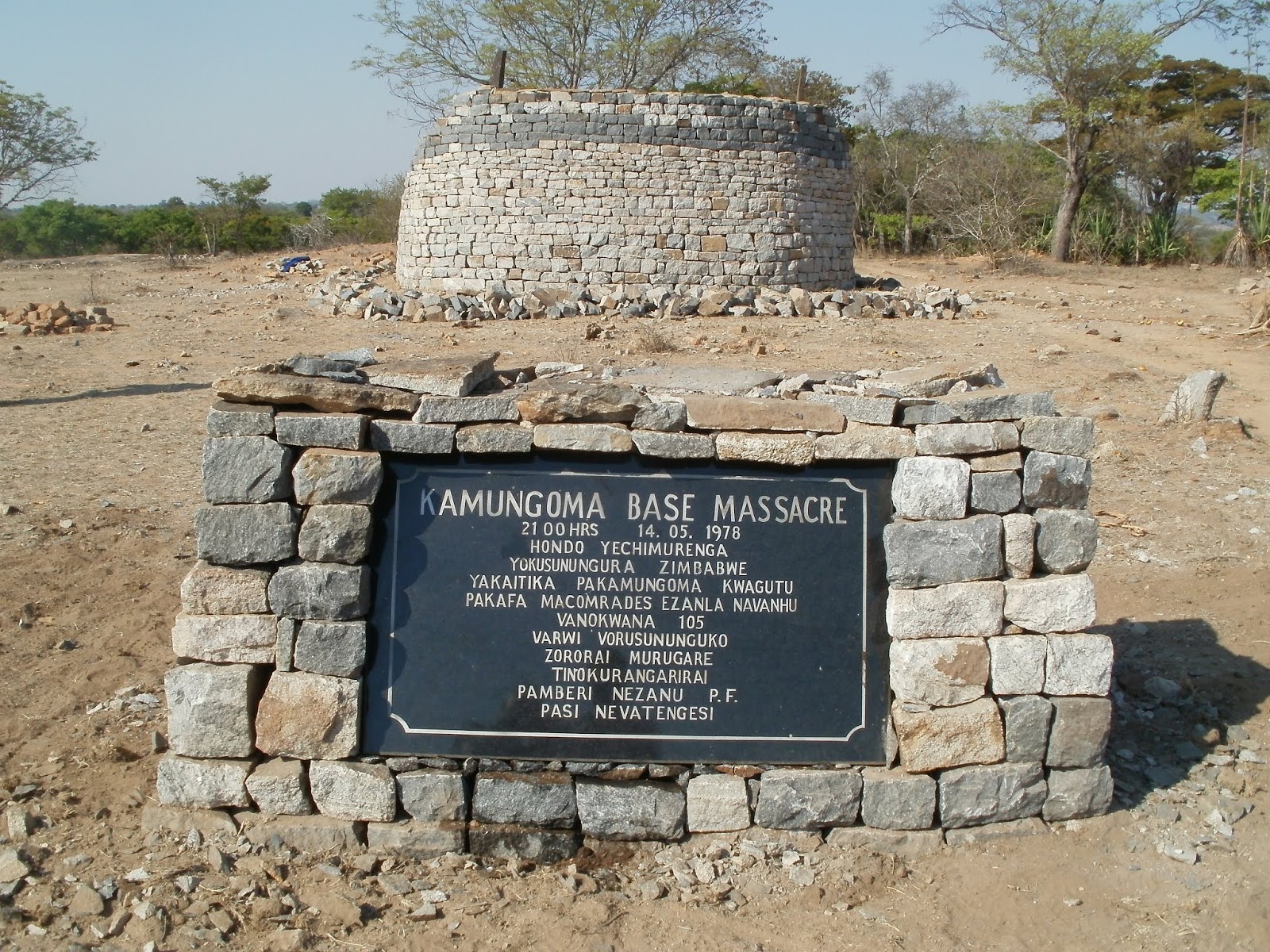
Kamungoma liberation war camp-site is situated 12 km Southeast of Bhasera growth point, which is in the South-eastern side of Zimbabwe. This site recorded the highest number of civilian people killed at the same time on a single day during the liberation struggle within Zimbabwe during the Zimbabwean liberation struggle. Locals holds the narrative that on the 14th of May 1978, about 105 people were killed by the Rhodesian forces during a pungwe (night vigil where the liberation fighters met and taught the masses about the strategies and reasons for the Liberation struggle). Amongst the contemporary locals is a number of individuals who are survivors to the 1978 event as well as relatives of those who perished. Ever since the 1980 when the country attained its independence, people in this part of Gutu area started commemorating such national holidays as the Heroes day, the Independence day, the Unity day at this very site. The celebrations however were done on this site most importantly to identify participants with the ruling Zanu pf political party as well as to commemorate the lives of the departed heroes. This community however approached the National Museums and Monuments of Zimbabwe (NMMZ) in the 2012, seeking the NMMZ’s intervention in constructing a memorial on the Kamungoma liberation war camp-site.


The community members
The NMMZ stone masons


The NMMZ had to do some research on the matter, as well as hosting planning meetings with the community leaders on what exactly was to be done.  A year later, on the 16th of October 2013, the NMMZ sent a team of nine to help the community erect a memorial at Kamungoma. Among the nine (all based at the Great Zimbabwe World Heritage Site) was the stone-masons as well as the two intern Honors student of which I was one of them. This team was being led by a curator of archaeology and it worked with the communities to construct the memorial which was built in a similarly to the Great Zimbabwe free-standing dry-stone structures.  The construction was regarded by the community as tangible form of remembering the dead and commemorating them. According to the community, the Great Zimbabwe known locally as the dzimbabwe meaning residence and burial of the kings/owned hence the dry stone structure as well as the conical tower was the best possible way of immortalizing the memory both of the event and the people who perished at this very site. A black graphited panel with inscriptions of the manes of those who perished during the massacre placed on the wall and this was done to ensure their being remembered.

The site after completion of the memorial